Seasonal & Holiday Inventory Liquidation
Seasonal inventory liquidation moves leftover holiday stock before it becomes year-old dead stock, from off-price seasonal buyers to storage-versus-liquidate math.
Hylke Reitsma is co-founder of Forthsuite and a supply chain specialist with 8+ years of hands-on experience at Shell, Verisure, and Stryker. He holds an MSc in Supply Chain Management from the University of Groningen and writes practical guides to help e-commerce teams run leaner, faster supply chains. Selected by Replit as 1 of 20 founders for the inaugural Race to Revenue Cohort #1 (2026) and certified as a Replit Platform Builder.
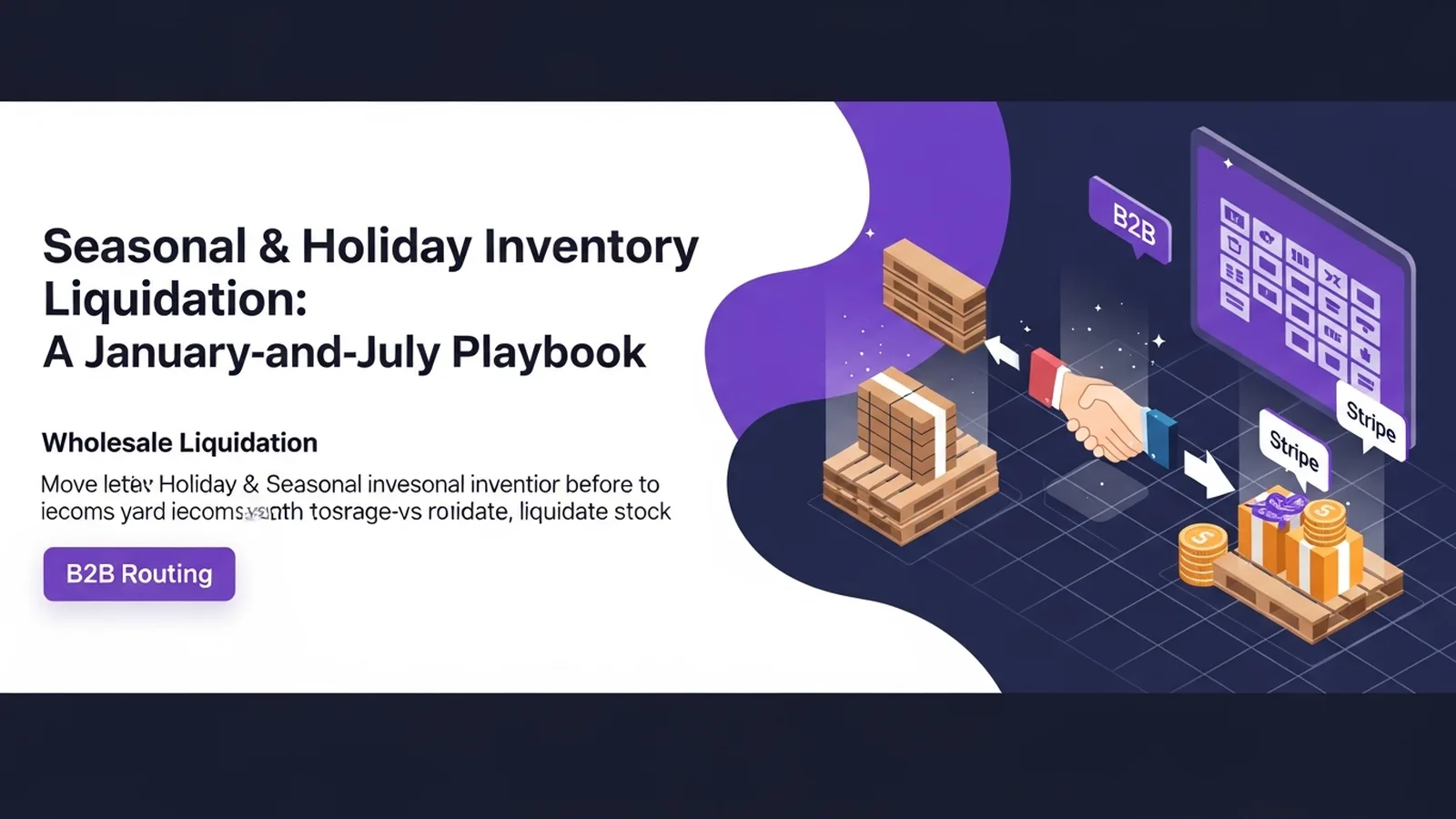
Seasonal & Holiday Inventory Liquidation: Don't Let It Become Dead Stock
TL;DR: Liquidate leftover seasonal and holiday inventory immediately using off-price buyers, storage cost analysis, and B2B channels to prevent it from becoming worthless dead stock by next year. Forthclear connects Shopify operators with secondary-market buyers to quickly move overstock and seasonal deadstock through established liquidation channels, turning excess inventory into recovered capital.
Last updated: July 2026
TL;DR. Move leftover holiday and seasonal inventory before it becomes year-old dead stock. Off-price seasonal buyers, storage-vs-liquidate math, and B2B routing.
This guide is one of 20 vertical spokes inside the Wholesale Liquidation Guide. The pillar covers the cross-category recovery framework (channel ladder, pricing stack, holding-cost math); this spoke covers what works specifically for seasonal and holiday overstock on Shopify. The short answer to "How do I liquidate leftover seasonal and holiday inventory?": match channel to brand-protection tolerance and recovery-rate target using the ladder below.
The 'store it or move it' decision: holding cost vs. recovery delta
The defining math of seasonal liquidation is whether storing for next year beats clearing now. Annualized holding cost (warehouse + insurance + capital) typically runs 22–32% of inventory value.
If next-year recovery is forecast within 25 percentage points of liquidate-now recovery, hold-and-resell-next-year almost never wins. The right test: compare (sell now at X%) vs (sell next year at Y% minus Z% holding cost minus 5–10% obsolescence drift).
Off-price seasonal buyers (Big Lots, Ollie's, Five Below)
Big Lots is the dominant US seasonal-clearance buyer, paying a moderate share of MSRP for branded holiday and seasonal closeouts in dedicated January and July buying windows. Ollie's Bargain Outlet takes branded seasonal at 22–40% with year-round buying.
Five Below caps ASP at $5 but moves seasonal volume fast at 18–30% recovery for SKUs that fit the price point.
Dollar-channel routing for low-ASP seasonal goods
Dollar Tree and Family Dollar buy low-ASP seasonal opportunistically through brokers, with January and July as the active windows. Recovery 12–25% but velocity is enormous — full truckloads move in 21–45 days.
The wrong channel for premium branded seasonal where price-anchor damage exceeds the cash recovery.
International export to opposite-hemisphere markets
Southern-hemisphere export (Australia, New Zealand, Argentina, Chile, South Africa) accepts US Q4 holiday and US summer-seasonal goods in their corresponding seasons. Recovery 25–42% on branded seasonal with 8–14 week ocean transit.
Christmas/winter goods exporting in Q1 land in Australian winter; US summer goods exporting in Q4 land in southern-hemisphere summer. Brand-protection upside is real.
Storage-and-resell-next-year math (when it actually works)
Holding for next year wins for: (1) brand-protected current-design goods where next-year recovery is forecast within 10 points of this-year retail (rare), and (2) classic SKUs (e.g. white string lights, basic ornaments) where 12-month holding cost is below the recovery delta. Almost never works for theme-of-the-moment seasonal where design obsolescence drift is 8–15% per year.
How Forthclear helps brands clear seasonal overstock fast
Forthclear's seasonal buyer pool is calendar-aware, with Big Lots/Ollie's-style off-price, dollar-channel, and southern-hemisphere export distributors all matched against your aging inventory in the right window. Brands that miss the January window can route to southern-hemisphere export in Q1 and recover materially better than waiting until July.
FAQ
How do I liquidate leftover seasonal and holiday inventory?
Move leftover holiday and seasonal inventory before it becomes year-old dead stock. Off-price seasonal buyers, storage-vs-liquidate math, and B2B routing. The framework above is the operator answer in under 1,500 words; the cross-category context lives in the Wholesale Liquidation Guide pillar.
What recovery rate should I expect when I liquidate seasonal and holiday inventory?
Recovery in seasonal and holiday liquidation is bracketed by channel: specialty B2B and Forthclear-style verified-buyer marketplaces typically pay the most for cost recovery; off-price retail pays less; mixed-pallet jobbers pay the least. Specifics depend on brand strength, season, and SKU/curve completeness.
Does Forthclear support seasonal inventory liquidation?
Yes. Forthclear is built for Shopify merchants moving excess inventory in verticals like seasonal and holiday. You set your asking price, and Forthclear connects your surplus stock with bulk B2B buyers on its standalone marketplace.
Where does this fit in the broader Wholesale Liquidation Hub?
This spoke is one of 20 inside the Wholesale Liquidation Guide pillar. The pillar covers the full operator overview across every vertical; come back to this spoke when you specifically need to solve seasonal inventory liquidation.
Next step
For the cross-category playbook, the Wholesale Liquidation Guide stitches all 20 vertical spokes together. If you want to ship seasonal and holiday liquidation in one afternoon on Shopify, connect Forthclear and get verified-buyer matches inside 48 hours.
Timing your seasonal liquidation: the 90-day window
The most profitable liquidation happens in a narrow window: immediately after the season ends, while buyer demand for that category is still active. Off-price retailers plan their seasonal buys months in advance and have fixed acquisition schedules.
Missing a buyer's window by even two weeks can drop your recovery rate significantly, because the next buyer cohort won't be looking until the following season.
For Q4 holiday inventory, the critical window is mid-January through February. For Q2 summer seasonal goods, it's late July through August. Delaying past these windows forces you into either storage-and-wait (which the math rarely supports) or distressed clearance channels that pay substantially less. Start conversations with potential buyers 30 days before your target liquidation date, not after inventory is already sitting.
Assessing your seasonal stock before you list: grade by resaleability
Not all overstock moves at the same speed or price. Before committing inventory to a liquidation channel, segment your seasonal goods by condition and design durability.
Grade A stock—full-case, original packaging, current-season branded items in good condition—moves fastest and commands the highest recovery rates. These are your priority for premium channels like Big Lots or international export.
Grade B stock includes open-case goods, minor packaging damage, or items one season old but still relevant (e.g., winter décor in March). These work well for dollar channels or regional off-price buyers who prioritize volume over pristine presentation.
Grade C stock—heavily worn, mixed lots, or truly obsolete designs—may only be viable for bulk liquidators, donation (for tax write-off), or recycling. Trying to force Grade C into premium channels wastes time and kills your recovery rate for better stock.
Sorting by grade takes time upfront but prevents you from underselling premium inventory alongside clearance goods.
The storage trap: why keeping seasonal inventory "just in case" usually fails
Retailers often rationalize holding seasonal goods by assuming next year's demand will justify the wait. In practice, several forces work against this logic.
Design preferences shift annually—what sold well this Christmas may feel dated next December. Consumer taste in holiday colors, themes, and aesthetics evolves faster than most sellers expect. Beyond design drift, physical deterioration happens even in climate-controlled storage: colors fade, materials become brittle, and packaging degrades.
The real cost isn't just warehouse rent. It includes insurance, handling labor to rotate stock, opportunity cost of the capital tied up, and the risk of damage or shrink. These holding costs accumulate monthly and are easy to underestimate. If you forecast that next year's goods will sell for only slightly less than clearing now, the math tips toward liquidating immediately. You recover cash, free up space, and eliminate storage risk.
What happens when you miss the buyer window? Second-tier options
If your target liquidation window closes—perhaps because inventory arrived late or you delayed the decision—you're not without options, but recovery rates drop. Regional discount chains and liquidation marketplaces that don't operate on fixed seasonal schedules will still consider your goods, but they expect deeper discounts because they're absorbing the speed and uncertainty premium.
Online liquidation platforms can move seasonal goods year-round, but at lower recovery. This is where listing on a verified B2B marketplace like Forthclear becomes valuable: you can reach multiple buyer tiers simultaneously and move goods faster than waiting for the next scheduled buyer window.
How should you price seasonal inventory to move quickly?
Seasonal goods sitting unsold are worth less every week. Set an aggressive opening price that reflects the true cost of storage and capital, rather than anchoring to MSRP.
Buyers expect seasonal clearance to be heavily discounted; positioning your goods as premium delays the sale and guarantees storage costs. Price to sell in the window, not to maximize per-unit margin.
About the Author

Hylke Reitsma is co-founder of Forthsuite and a supply chain specialist with 8+ years of hands-on experience at Shell, Verisure, and Stryker. He holds an MSc in Supply Chain Management from the University of Groningen and writes practical guides to help e-commerce teams run leaner, faster supply chains. Selected by Replit as 1 of 20 founders for the inaugural Race to Revenue Cohort #1 (2026) and certified as a Replit Platform Builder.
LinkedIn