Furniture Liquidation Guide
Sell excess furniture inventory through clearance retailers, B2B liquidators, and hospitality buyers. LTL freight math, damage grading, and refurb routing.
Hylke Reitsma is co-founder of Forthsuite and a supply chain specialist with 8+ years of hands-on experience at Shell, Verisure, and Stryker. He holds an MSc in Supply Chain Management from the University of Groningen and writes practical guides to help e-commerce teams run leaner, faster supply chains. Selected by Replit as 1 of 20 founders for the inaugural Race to Revenue Cohort #1 (2026) and certified as a Replit Platform Builder.
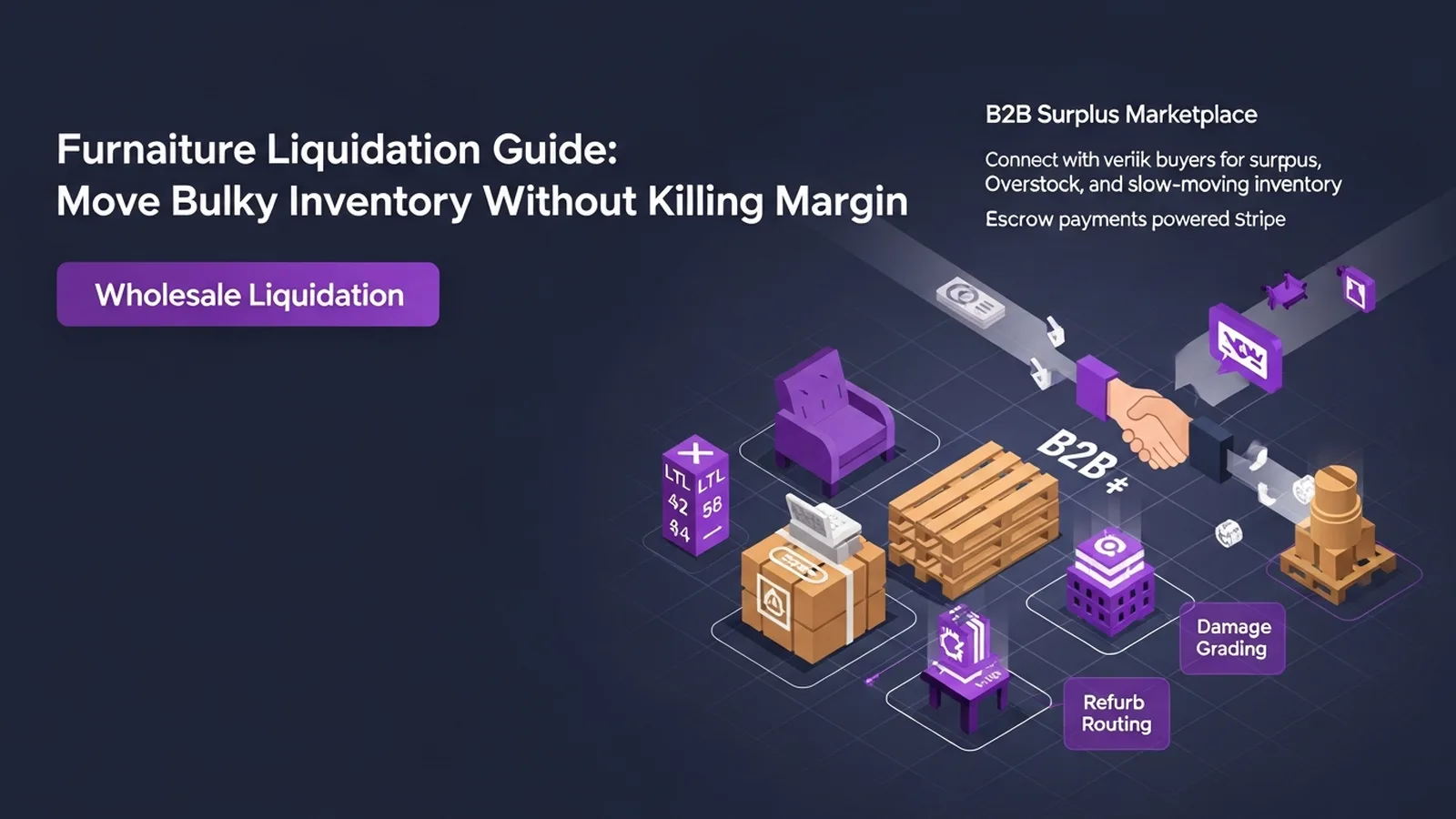
Furniture Liquidation: A Bulky-Goods Recovery Playbook
Last updated: May 2026
TL;DR: Sell excess furniture inventory through clearance retailers, B2B liquidators, and hospitality buyers while optimizing LTL freight costs, damage grading, and refurbishment routing to preserve margins. Forthclear connects Shopify merchants with secondary-market buyers to liquidate overstock and deadstock furniture through established channels that handle bulky items efficiently.
TL;DR. Sell excess furniture inventory through clearance retailers, B2B liquidators, and hospitality buyers. LTL freight math, damage grading, and refurb routing.
This guide is one of 20 vertical spokes inside the Wholesale Liquidation Guide. The pillar covers the cross-category recovery framework (channel ladder, pricing stack, holding-cost math); this spoke covers what works specifically for furniture overstock on Shopify. The short answer to "How do I liquidate excess furniture inventory?": match channel to brand-protection tolerance and recovery-rate target using the ladder below.
Why furniture liquidation is dominated by freight cost
Furniture is the only liquidation vertical where outbound freight regularly exceeds 30% of recovery value. A $400 sofa moves on LTL at $180–320 per piece domestically — if recovery is 25%, freight eats two-thirds of net. Local-pickup-only liquidation typically recovers 12–20 percentage points more than freight-included because the buyer absorbs logistics. Build a localized buyer pool BEFORE you list nationally.
Clearance retailers (American Freight, Big Lots) and B2B liquidators
American Freight (formerly Sears Outlet) buys furniture overstock and grade-B at 25–42% of cost, with regional buying offices in Atlanta, Dallas, and Cleveland. Big Lots takes branded living-room and bedroom sets at 22–38% recovery; lead time is 8–12 weeks. CORT Furniture Outlet sources used-fleet and overstock at 18–30% recovery for the rental-to-resale flow.
Hospitality, multifamily, and contract buyers
Hotels, multifamily property managers, and student-housing operators buy furniture in bulk for refresh cycles every 5–7 years. They pay 30–55% recovery on commercial-grade pieces, often higher than retail liquidation, with the trade-off of needing 50+ matching units. Aggregators like Hospitality Outfitters and Forthclear's contract-buyer pool match overstock to active hotel/multifamily refresh projects.
Damage grading: A/B/C and refurb routing
Standard furniture grading: A = retail-ready, B = minor cosmetic, C = structural repair required. A-grade routes to off-price retail at 30–45% recovery; B-grade routes to outlet and contract buyers at 18–30%; C-grade routes to refurb partners (typically regional upholsterers) who buy at 8–15% and resell B-grade after rework. Skipping grading and listing mixed lots cuts recovery by 30–50% — buyers price for the worst piece they see in the photos.
Local pickup vs. LTL freight economics
For furniture under $300 ASP, local pickup is almost always net-better than LTL. A 50-unit local-pickup lot to a regional buyer at 22% recovery typically nets more cash than a 50-unit LTL lot at 35% recovery once you net out $9–14k of freight. Forthclear's furniture buyer pool is geo-tagged so the matching surface defaults local first.
How Forthclear matches furniture overstock with regional buyers
Forthclear's furniture pool includes contract buyers (hotels, multifamily, student housing), regional clearance retailers, and refurb partners — matched against your warehouse zip to minimize freight. The platform's Shopify integration accepts grade tags (A/B/C) per SKU and routes each grade to the right buyer segment automatically.
FAQ
How do I liquidate excess furniture inventory?
Sell excess furniture inventory through clearance retailers, B2B liquidators, and hospitality buyers. LTL freight math, damage grading, and refurb routing. The framework above is the operator answer in under 1,500 words; the cross-category context lives in the Wholesale Liquidation Guide pillar.
What recovery rate should I expect when I liquidate furniture inventory?
Recovery in furniture liquidation is bracketed by channel: specialty B2B and Forthclear-style verified-buyer marketplaces typically pay 35–65% of cost; off-price retail pays 22–45%; mixed-pallet jobbers pay 8–18%. Specifics depend on brand strength, season, and SKU/curve completeness.
Does Forthclear support furniture liquidation guide?
Yes. Forthclear is built for Shopify merchants moving excess inventory in verticals like furniture. You set a floor price, Forthclear matches your stock with verified B2B buyers under NDA and channel-control contracts, and the Shopify integration handles inventory drawdown automatically when a buyer commits.
Where does this fit in the broader Wholesale Liquidation Hub?
This spoke is one of 20 inside the Wholesale Liquidation Guide pillar. The pillar covers the full operator overview across every vertical; come back to this spoke when you specifically need to solve furniture liquidation guide.
Next step
For the cross-category playbook, the Wholesale Liquidation Guide stitches all 20 vertical spokes together. If you want to ship furniture liquidation in one afternoon on Shopify, connect Forthclear and get verified-buyer matches inside 48 hours.
B2B Surplus and Liquidation in 2026: What's Changed
The furniture liquidation market has tightened considerably since late 2024. Corporate office downsizing has plateaued after three years of churn, meaning the flood of mid-tier office furniture that propped up secondary markets is now a trickle. At the same time, B2B buyers have become significantly more selective—sustainability reporting requirements and Extended Producer Responsibility regulations in California and the EU mean procurement teams now track the full lifecycle of bulky goods, not just first-mile sourcing.
For operators moving surplus furniture inventory, this creates a paradox: less supply competition but pickier buyers. The liquidators still clearing volume profitably are the ones who can provide item-level condition data, proof of refurbishment standards, and increasingly, carbon accounting for transport and disposal. Bulk "as-is" lots that moved easily in 2023 now sit longer or command 15-20% lower recovery rates unless they come with detailed manifests and quality attestation.
Watch how quickly AI-based condition assessment tools get adopted in the next 12 months. Several large 3PLs are piloting computer vision systems that automatically grade furniture condition during intake, reducing the manual bottleneck that kills margin on low-value bulky items. If the accuracy holds, expect this to become table stakes for competitive liquidation pricing by 2027.
Timing Your Liquidation: Seasonal and Inventory-Age Considerations
Furniture liquidation success often hinges on when you list. Overstock sitting in your warehouse depreciates in value—not just from holding costs, but from style obsolescence, fabric fading, and buyer perception of aged inventory. The longer a piece sits, the more aggressively you'll need to price it to move.
Seasonal demand peaks vary by furniture type. Bedroom sets and upholstered pieces see stronger buyer interest in late summer and early fall, when hospitality and multifamily operators plan refresh cycles. Office and commercial-grade furniture moves more consistently year-round, but contract buyers often have budget cycles that cluster around fiscal quarters. Conversely, liquidating summer patio furniture in November means competing on a smaller buyer pool and accepting lower recovery rates.
The practical takeaway: list inventory before it becomes "aged stock." If a sofa has been in your warehouse for eight months, the margin loss from faster liquidation almost always outweighs the benefit of holding for a "better" season. Check your inventory system for pieces marked as overstock or discontinued, and prioritize those in your listing queue.
Preparing Furniture for Buyer Inspection: Photography, Condition Notes, and Dimensions
Buyers in the B2B furniture market are experienced, but they still need clear, honest information before committing to bulk purchases. Poor photos or vague condition descriptions lead to deal cancellations, rejected lots, or forced price reductions after inspection.
Start with photography. Take images from multiple angles—front, side, back, and close-ups of any damage, stains, or wear. Photograph the underside and frame structure if selling to commercial buyers; they care about durability. Use natural light and avoid angles that hide problem areas. Buyers expect to see flaws; hiding them destroys trust and kills future business.
Condition notes should be granular. Rather than "good condition," write: "Light surface scratches on left arm, no structural damage, fabric intact, legs stable." This specificity signals professionalism and reduces post-sale disputes. Include measurements (width, depth, height, seat height) and material breakdown (wood frame, polyurethane foam, linen upholstery, metal legs). Commercial buyers and hospitality operators use these specs to assess fit and durability for their use case.
Damage grading should be consistent. If you're listing a mixed lot of 10 sofas, note which pieces are A-grade (retail-ready), which are B-grade (minor cosmetic issues), and which are C-grade (structural repair needed). This transparency typically increases buyer confidence and recovery rate compared to a vague "as-is" listing.
What Happens When You Can't Sell Locally: Regional and National Buyer Networks
Not every merchant has access to a strong local furniture buyer pool. If local pickup isn't an option, regional networks become critical. National clearance retailers have established buying offices, but they receive hundreds of inquiries and may pass on smaller or niche inventory. Regional aggregators and secondary-market platforms fill this gap by connecting you with multiple buyer types—some focused on specific geographies, others specializing in hospitality or contract bulk buys.
When pursuing national channels, expect longer lead times for inspection and payment. A buyer might need 2–4 weeks to evaluate photos and request a site visit. Plan your cash flow accordingly. Also clarify who handles freight: some buyers expect it included in the quoted recovery percentage, while others assume pickup at your location. This detail shifts your margin significantly, so confirm in writing before accepting an offer.
How Should You Grade Furniture Damage for Liquidation?
Grading is where most merchants leave money on the table. Many list mixed-condition lots without separating by quality, forcing buyers to quote based on the worst piece in the group. Instead, sort before you list. A-grade pieces (no visible damage, retail-ready) command higher recovery from off-price retailers. B-grade (minor cosmetic wear) appeals to outlet and contract buyers. C-grade (repair-needed) routes to refurbishment specialists. Spending an hour on grading can lift your total recovery by 20–30 percentage points across the lot.
About the Author

Hylke Reitsma is co-founder of Forthsuite and a supply chain specialist with 8+ years of hands-on experience at Shell, Verisure, and Stryker. He holds an MSc in Supply Chain Management from the University of Groningen and writes practical guides to help e-commerce teams run leaner, faster supply chains. Selected by Replit as 1 of 20 founders for the inaugural Race to Revenue Cohort #1 (2026) and certified as a Replit Platform Builder.
LinkedIn