Cross-Industry Surplus Collaboration Study
Cross-industry collaboration on surplus recovers more value: the strategies top sellers use to maximize liquidation.
Hylke Reitsma is co-founder of Forthsuite and a supply chain specialist with 8+ years of hands-on experience at Shell, Verisure, and Stryker. He holds an MSc in Supply Chain Management from the University of Groningen and writes practical guides to help e-commerce teams run leaner, faster supply chains. Selected by Replit as 1 of 20 founders for the inaugural Race to Revenue Cohort #1 (2026) and certified as a Replit Platform Builder.
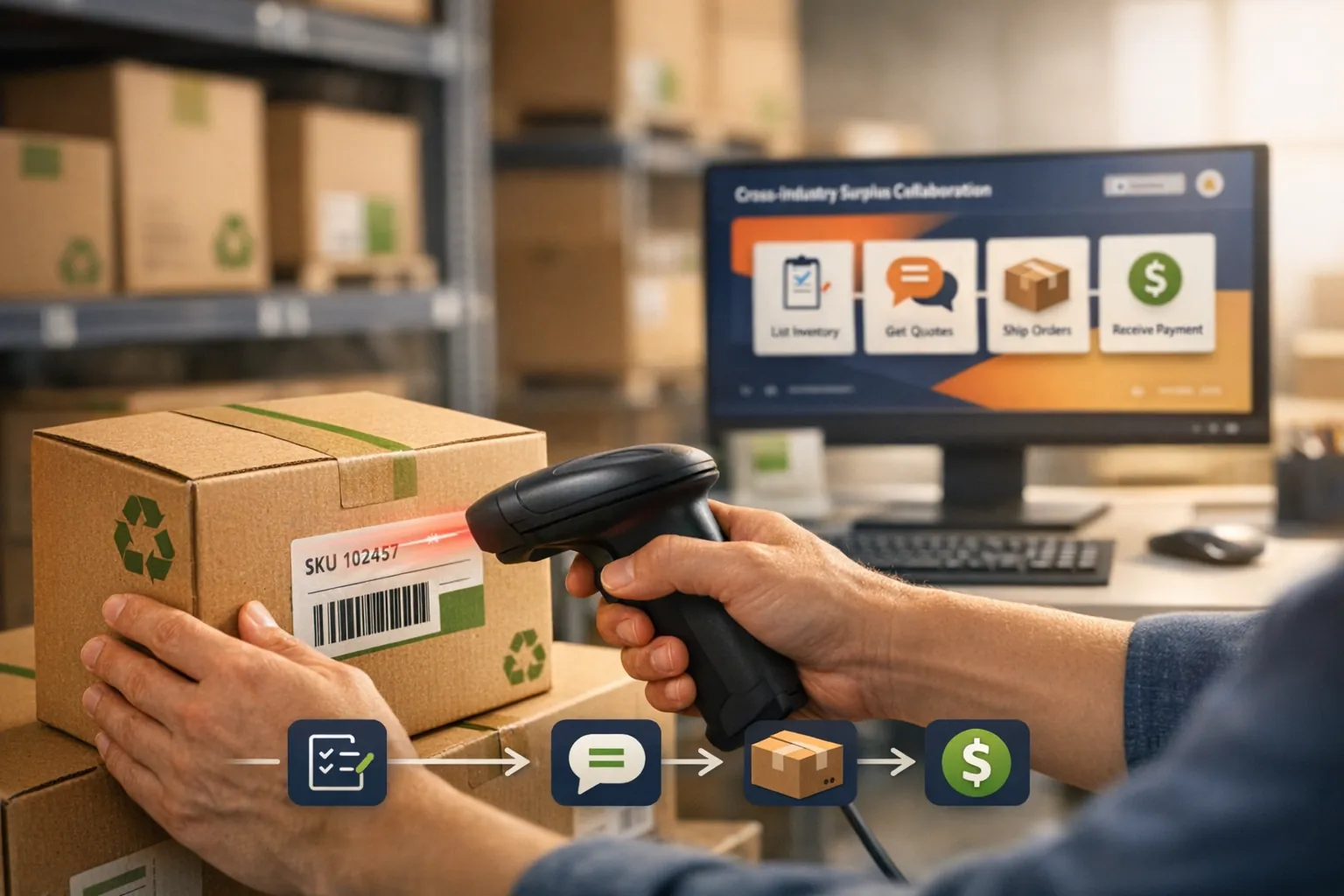
TL;DR: Cross-industry surplus collaboration works when one organization can use a safe, well-described output that another organization no longer needs. The evidence supports a hierarchy: prevent surplus first, preserve the product’s intended use where possible, then consider resale, donation, material reuse, recycling, and finally disposal. It does not support treating every overstock item as an industrial input or attaching environmental claims without a documented baseline and disposition record.
Last updated: September 2026
Fact-checked 23 July 2026 against primary and first-party sources. This replacement distinguishes measured examples from operating guidance; it is not a Forthclear study and does not estimate avoided emissions for your inventory.
What cross-industry surplus collaboration means
Cross-industry surplus collaboration is a practical form of resource matching. A usable product, material, by-product, or service capacity that has lost value in one workflow may still have a valid use in another.
The strongest industrial examples involve known material specifications, repeatable volumes, compatible facilities, and clear responsibility for transport and quality. Retail overstock can participate too, but the decision is usually closer to secondary resale, donation, refurbishment, or recycling than to heavy-industry symbiosis.
The distinction matters because “surplus” is not a safety or legal classification. A sealed consumer product, a short-dated food item, a cosmetic with damaged packaging, a battery, and a production by-product all require different evidence and different counterparties. Before searching for a buyer, the owner must determine whether the item may legally be resold, donated, exported, dismantled, recycled, or used as an input. Product restrictions, recalls, hazardous-material rules, brand agreements, intellectual-property rights, and local waste rules can override the most attractive commercial option.
The US Environmental Protection Agency’s non-hazardous materials hierarchy places source reduction and reuse ahead of recycling, energy recovery, treatment, and disposal. That is a useful decision order, not a claim that the first option is feasible for every item. EPA’s guidance on industrial secondary materials also explains that a proposed beneficial use should provide a functional benefit, meet product specifications, and avoid unacceptable health or environmental concerns.
What the published evidence actually shows
Industrial symbiosis is a network of specific exchanges
Kalundborg Symbiosis describes a partnership of fourteen public and private organizations that has developed resource exchanges since 1972. Its operating principle is concrete: a residual stream from one company becomes a resource for another. The network shares or reuses flows such as water, energy, and materials. This is evidence that long-running cross-company exchange can work; it is not evidence that any unsold retail SKU automatically has an industrial buyer.
The transferable lesson is the operating structure. Each exchange needs a defined material or service, an identified receiver, agreed specifications, infrastructure, and a commercial reason for both parties to continue. A one-off introduction can start a relationship, but repeatability and quality control turn it into a dependable channel.
Food redistribution preserves an existing use
In an April 2021 announcement, FoodCloud and Musgrave MarketPlace reported that their partnership had redistributed 334 tonnes of food, equivalent to more than 795,000 meals, to 410 charities since 2016. The announcement estimated the donated food’s value at more than €1 million and reported more than one million kilograms of avoided carbon-dioxide-equivalent emissions.
Those figures belong to that named program and its stated methodology. They should not be copied into an ecommerce forecast or used as a conversion factor for unrelated goods. The example is still instructive: the food retained its intended use, the receiving organizations were known, and the program recorded quantities and recipients. That evidence chain is more defensible than a generic statement that “collaboration reduces waste.”
Repurposing results need the right unit and baseline
ReFED’s account of a university foodservice research sprint describes nearly forty leaders from nine institutions working for twelve weeks on ways to repurpose overproduced food into other menu items. It is an example of collaboration and operational learning within a sector. We do not repeat the article’s environmental total here because a merchant should use the underlying report, unit definitions, and calculation boundary before relying on any headline number.
A defensible surplus-disposition hierarchy
| Priority | Possible route | Minimum evidence | Key decision question |
|---|---|---|---|
| 1 | Prevent or reduce | Demand, purchase-order, return, and ageing records by SKU | Can ordering, assortment, packaging, or return policy prevent recurrence? |
| 2 | Primary-channel recovery | Condition, remaining shelf life, price history, and channel permission | Can the item still be sold for its intended use without misleading the buyer? |
| 3 | Secondary resale | Accurate manifest, photos, title status, restrictions, and net proceeds | Does a qualified buyer accept the condition and downstream restrictions? |
| 4 | Donation or redeployment | Recipient eligibility, product suitability, transfer record, and valuation basis | Can the original function be preserved safely and lawfully? |
| 5 | Parts or material reuse | Composition, contamination status, specifications, and receiver process | Does the output provide a real functional input that meets the receiver’s requirements? |
| 6 | Recycling, treatment, or disposal | Material classification, licensed provider, weight ticket, and certificate where applicable | What compliant route remains after higher-value options are ruled out? |
How an ecommerce team can run the process
1. Build a condition-aware inventory census
Start with units, lot or batch, location, age, cost basis, current selling price, last sale date, expiry or best-before date, packaging state, recall status, and any channel restriction. Separate unopened saleable units from customer returns, damaged goods, components, and regulated materials. A total unit count without condition is not a usable manifest.
2. Put legal and safety gates before price discovery
Identify restrictions that affect transfer, advertising, export, donation, disassembly, or disposal. Ask the brand owner, compliance adviser, insurer, carrier, and waste provider where necessary. A marketplace listing or buyer offer does not transfer the seller’s regulatory duties automatically.
3. Match the route to the item, not the slogan
Preserve the intended use when that is safe and permitted. Consider a material exchange only when the receiver can name the function, specification, quantity, handling method, and rejection criteria. “Someone might reuse it” is not a disposition plan.
4. Compare net outcomes on the same boundary
For each route, record gross proceeds or avoided cost, marketplace and payment fees, freight, handling, inspection, repackaging, tax, destruction, and staff time. Also record the quantity that actually reached the approved destination. Do not call an outcome “recovered” merely because inventory left the warehouse.
5. Keep a claim ledger
If the company publishes a financial or environmental result, retain the source quantity, unit, baseline, calculation method, exclusions, date range, and supporting documents. Attribute third-party program figures to that program. Avoid converting weight into emissions without an appropriate factor and documented boundary. This prevents a sound disposal project from turning into an indefensible marketing claim.
Where a surplus marketplace fits
A marketplace can help expose a manifest to potential buyers, but it does not replace condition grading, legal review, buyer qualification, or a written transaction record. When evaluating Forthclear or another channel, confirm the live seller terms, buyer checks, payment flow, fees, dispute process, permitted goods, data handling, and logistics responsibility before listing.
Product capabilities and commercial terms can change, so the current service documentation should control.
Frequently Asked Questions
Is cross-industry surplus collaboration the same as liquidation?
No. Liquidation is a commercial disposition route, usually focused on selling inventory outside the primary channel. Cross-industry collaboration is broader and can include reuse of materials, energy, water, capacity, or products by another sector. Some liquidation transactions support reuse, but the terms are not interchangeable.
Can every surplus product be repurposed?
No. Condition, safety, composition, intellectual-property rights, product regulation, and local waste rules may limit reuse. A receiver also needs a real functional use and appropriate handling capability. If those conditions are absent, a licensed recycling, treatment, or disposal route may be required.
How should a business measure value recovery?
Use net proceeds, not the buyer’s headline offer. Subtract fees, freight, handling, inspection, repackaging, taxes, and internal labor on a consistent basis. Keep disposal or storage cost avoided as a separate line so the team can see which part of the result came from cash and which came from avoided expense.
What evidence is needed for an environmental claim?
Retain the measured quantity and unit, prior baseline, actual destination, calculation method, factor source, time period, exclusions, and any third-party assurance. Attribute external case-study figures to their named program. If those records do not exist, describe the activity without claiming a quantified environmental result.
About the Author

Hylke Reitsma is co-founder of Forthsuite and a supply chain specialist with 8+ years of hands-on experience at Shell, Verisure, and Stryker. He holds an MSc in Supply Chain Management from the University of Groningen and writes practical guides to help e-commerce teams run leaner, faster supply chains. Selected by Replit as 1 of 20 founders for the inaugural Race to Revenue Cohort #1 (2026) and certified as a Replit Platform Builder.
LinkedIn