Toy Liquidation Guide: Clear Overstock
Sell excess toy inventory after the holidays without dumping into your own channels. Off-price toy buyers, dollar channels, CPSIA compliance, and donation tax math.
Hylke Reitsma is co-founder of Forthsuite and a supply chain specialist with 8+ years of hands-on experience at Shell, Verisure, and Stryker. He holds an MSc in Supply Chain Management from the University of Groningen and writes practical guides to help e-commerce teams run leaner, faster supply chains. Selected by Replit as 1 of 20 founders for the inaugural Race to Revenue Cohort #1 (2026) and certified as a Replit Platform Builder.
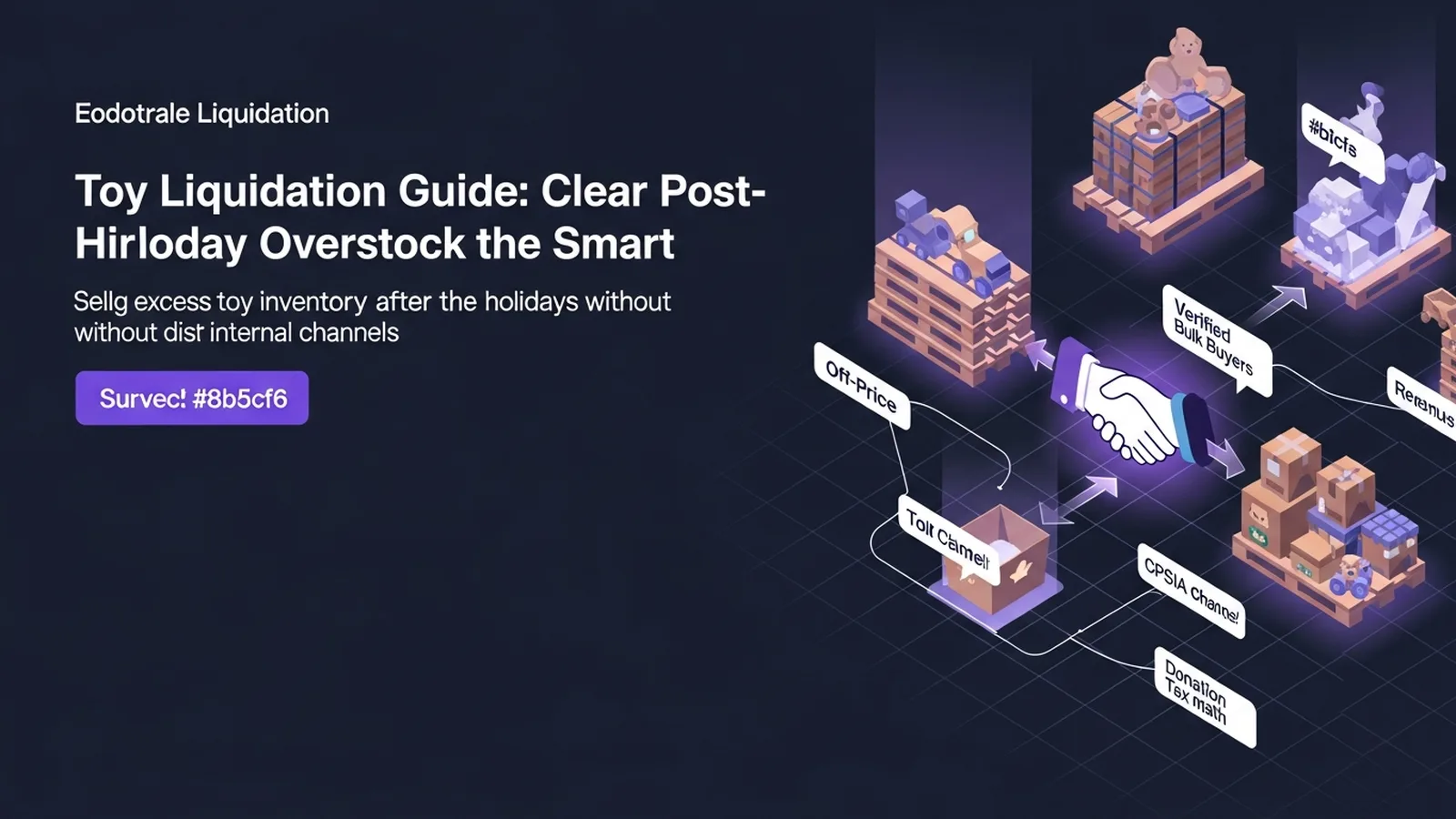
Toy Liquidation: A Post-Holiday Recovery Playbook
TL;DR: Clear post-holiday toy overstock by selling to off-price buyers, dollar channels, or donating for tax benefits while maintaining CPSIA compliance and protecting your primary sales channels. Forthclear helps Shopify operators liquidate excess toy inventory through vetted secondary-market channels that keep overstock out of your core customer base.
TL;DR. Sell excess toy inventory after the holidays without dumping into your own channels. Off-price toy buyers, dollar channels, CPSIA compliance, and donation tax math.
This guide is one of 20 vertical spokes inside the Wholesale Liquidation Guide. The pillar covers the cross-category recovery framework (channel ladder, pricing stack, holding-cost math); this spoke covers what works specifically for toys overstock on Shopify. The short answer to "How do I liquidate excess toy inventory after the holiday season?": match channel to brand-protection tolerance and recovery-rate target using the ladder below.
Why toy overstock is a January problem
The toy industry shifts ~55% of US retail volume in Q4 (Toy Association 2025). Brands that misjudge holiday demand face a 90-day window in January–March to clear before slow-spring demand turns toys into year-old dead stock. Recovery rates drop ~10 percentage points each quarter past Q4; clearing in January at 30% is materially better than clearing in July at 18%.
Off-price toy buyers (Five Below, Ollie's, Big Lots)
Five Below caps ASP near $5 and pays 18–32% of MSRP for branded toys that fit the price point — ideal for plush, small playsets, party-favor categories. Ollie's Bargain Outlet pays 22–40% on closeout branded toys with intact packaging, no ASP cap. Big Lots takes seasonal/holiday toy at 20–35% recovery, with strong January–February buying for “clearance refresh.”
Dollar-channel and discount routing
Dollar Tree and Family Dollar buy small toys (under $1.25 wholesale) opportunistically through brokers. Recovery is 12–25% but velocity is enormous — a full truckload moves in 30–45 days. Avoid for premium/branded toy where brand-equity damage exceeds the cash recovery.
CPSIA, age-grade, and choking-hazard compliance for liquidators
Under CPSIA, every toy retains its original manufacturer's General Conformity Certificate (GCC) and tracking-label obligations through resale. Liquidators cannot remove or alter age-grade or choking-hazard labels; doing so creates a violation that traces back to the original brand. Build the GCC documentation pack into the liquidation lot from day one.
Donation: Toys for Tots, Good360 — tax math under IRC 170(e)(3)
Toys for Tots accepts new-in-package branded toys year-round; Good360 routes branded toys to 100,000+ US nonprofits with full IRC 170(e)(3) documentation. For C-corp donors, the enhanced deduction (cost basis + half unrealized gain, capped at 2x basis) often beats Q1 liquidation recovery on aged Q4 overstock — particularly when you factor in CPSIA compliance overhead avoided.
How Forthclear matches toy overstock with verified B2B buyers
Forthclear's toy buyer pool is filtered for CPSIA-compliant operators — off-price chains, regional discount retailers, and Good360-linked donation aggregators. Brands set their floor and the platform routes January overstock to the channel paying top recovery for that age-grade and ASP segment.
FAQ
How do I liquidate excess toy inventory after the holiday season?
Sell excess toy inventory after the holidays without dumping into your own channels. Off-price toy buyers, dollar channels, CPSIA compliance, and donation tax math. The framework above is the operator answer in under 1,500 words; the cross-category context lives in the Wholesale Liquidation Guide pillar.
What recovery rate should I expect when I liquidate toys inventory?
Recovery in toys liquidation is bracketed by channel: specialty B2B and Forthclear-style verified-buyer marketplaces typically pay 35–65% of cost; off-price retail pays 22–45%; mixed-pallet jobbers pay 8–18%. Specifics depend on brand strength, season, and SKU/curve completeness.
Does Forthclear support toy liquidation guide?
Yes. Forthclear is built for Shopify merchants moving excess inventory in verticals like toys. You set a floor price, Forthclear matches your stock with verified B2B buyers under NDA and channel-control contracts, and the Shopify integration handles inventory drawdown automatically when a buyer commits.
Where does this fit in the broader Wholesale Liquidation Hub?
This spoke is one of 20 inside the Wholesale Liquidation Guide pillar. The pillar covers the full operator overview across every vertical; come back to this spoke when you specifically need to solve toy liquidation guide.
Next step
For the cross-category playbook, the Wholesale Liquidation Guide stitches all 20 vertical spokes together. If you want to ship toys liquidation in one afternoon on Shopify, connect Forthclear and get verified-buyer matches inside 48 hours.
Timing Your Toy Liquidation: Why January Matters More Than You Think
The window between mid-January and end-of-February is critical for toy overstock. After the holiday season closes, consumer demand for toys drops sharply, and retail shelf space gets reallocated to spring categories. If your overstock sits through March, you move from "fresh closeout" to "aged inventory," and buyer interest—along with recovery rates—declines noticeably each month you wait.
Buyers like Ollie's and Five Below run specific buying cycles in January and February designed to refresh clearance sections for post-holiday traffic. If you miss those windows, you're competing against summer overstock and back-to-school decisions rather than holiday-recovery demand. The practical takeaway: get your liquidation lot documented, photographed, and listed within the first two weeks of January. Delaying even to early March measurably reduces which channels will bid competitively.
Prepare your GCC documentation and inventory count in December so you're not scrambling in January. Having clean, organized compliance packs ready speeds up buyer due diligence and makes your lot more attractive to serious operators.
Protecting Your Brand While Liquidating: Channel Selection and Price Positioning
Not all liquidation channels are equal when it comes to brand protection. Selling overstock through off-price chains like Ollie's or regional dollar outlets means your product reaches bargain-hunting consumers—but it also means it appears on discount shelves, potentially training your regular customers to wait for markdowns instead of paying full retail.
If brand equity is a concern, donation through Good360 or Toys for Tots keeps your product out of the secondary retail landscape entirely, even though the immediate cash recovery is lower or zero. You still capture tax benefits, and your brand stays off discount floors where customers might see it and wonder why they paid full price online three months ago.
For commodity or seasonal toys—party favors, generic playsets, licensed tie-in toys tied to holiday events—channel choice is simpler: maximize recovery rate without worrying about downstream brand damage. But for signature products or items with strong brand positioning, weigh the tax upside of donation against the brand-protection cost of discount-channel exposure. Some merchants find a hybrid approach works best: donate your premium overstock and liquidate commodity toys through off-price buyers.
Managing Fulfillment and Logistics for Bulk Toy Liquidation
Toy lots typically move in full or half-truckload quantities once a buyer commits. Unlike small-parcel returns, liquidation requires palletizing, labeling for compliance, and coordinating pickup or freight from your warehouse. Plan for 5–10 business days between sale confirmation and truck pickup.
Make sure your warehouse team understands that liquidation lots must maintain GCC documentation and label integrity. A single damaged age-grade label or missing tracking tag can cause a buyer to reject an entire pallet. Brief your team on what makes a lot compliant before listing and be prepared to quarantine damaged units beforehand.
If you use a 3PL, confirm in advance that they can stage toy lots separately and that they understand CPSIA label requirements. Some fulfillment providers charge extra for bulk staging; factor that into your net recovery calculation.
Should You Liquidate or Donate? A Quick Decision Framework
Ask yourself three questions: (1) Do you have GCC and compliance documentation ready? (2) Is the toy category or brand sensitive to discount-channel exposure? (3) How much working capital do you need recovered in Q1?
If you answered yes to question 2 and no to question 3, donation often makes financial sense after you factor in tax benefits and compliance overhead avoided. If you need cash recovery and brand protection is less critical, off-price channels deliver faster working capital. If compliance documentation is incomplete, do not list until it's organized—incomplete lots get rejected, tying up inventory longer.
Work backward from your working-capital deadline and channel availability. List early in January to capture buyer momentum.
About the Author

Hylke Reitsma is co-founder of Forthsuite and a supply chain specialist with 8+ years of hands-on experience at Shell, Verisure, and Stryker. He holds an MSc in Supply Chain Management from the University of Groningen and writes practical guides to help e-commerce teams run leaner, faster supply chains. Selected by Replit as 1 of 20 founders for the inaugural Race to Revenue Cohort #1 (2026) and certified as a Replit Platform Builder.
LinkedIn